


Learning about your family history can be one of the most rewarding journeys you'll take. But for many African Americans, it is often more difficult to trace family origins than it is for people whose ancestry is documented through generations of written records.
For millions of families, traditional genealogy has been difficult because of historical events such as the transatlantic slave trade, migration, colonization, and poor historical documentation. Fortunately, advances in genetic testing have opened up new possibilities. DNA tests today can help you discover where your ancestors came from, connect you with relatives worldwide, and even give you useful information about your genetic background.
But with so many companies providing ancestry kits, it is not always straightforward to pick the right one.
So, which DNA test is best for African ancestry?
That depends on what you are looking to find out.
Some DNA tests will try to narrow it down to specific regions or ethnic groups within Africa. Some are good at linking you to living relatives or building a giant family tree. Some offer health information alongside ancestry reports, and a few are focused exclusively on genealogy.
In this guide, we will look at the top DNA testing companies, discuss their strengths and weaknesses, and help you to choose the best for you based on your goals.
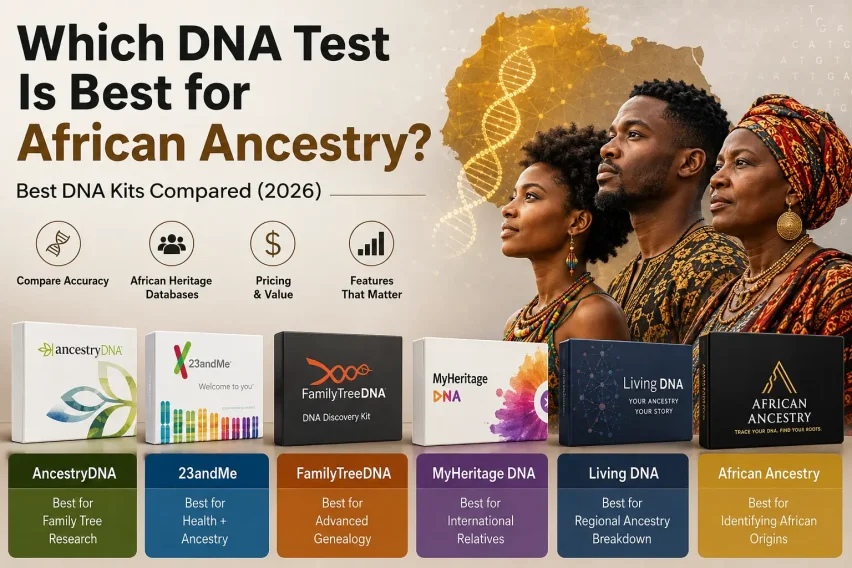
| DNA Test | Best For | Health Reports | Relative Matching | African Database |
| AncestryDNA | Family tree research | No | Excellent | Very Good |
| 23andMe | Health + ancestry | Yes | Good | Good |
| FamilyTreeDNA | Advanced genealogy | Optional | Excellent | Very Good |
| MyHeritage DNA | International relatives | No | Excellent | Good |
| Living DNA | Regional ancestry breakdown | No | Excellent | Good |
Each service offers unique advantages, so the best choice depends on what you want from your results.
Modern ancestry DNA kits test thousands of genetic markers across your genome. They compare these markers to reference populations around the world. The bigger and more diverse a company's database, the more granular your ancestry estimates can be.
Most companies use 3 different kinds of DNA testing:
This is the most common type of ancestry testing. It looks at your DNA from both your mother and your father to reveal your ethnicity over many generations.
It's ideal for:
Mitochondrial DNA is passed down almost exclusively from mother to child. It can help track your direct maternal line and sometimes even identify ancient African maternal origins.
Y-DNA is patrilineal (passed down only on the paternal line) and is only available to biological males. This type of testing is particularly useful for tracing direct paternal lineage back hundreds and even thousands of years.
If your primary goal is discovering where your African ancestors came from, African Ancestry is widely considered one of the strongest options available. Unlike many mainstream DNA companies that divide Africa into broad geographic regions, African Ancestry specializes in identifying present-day African countries and ethnic groups whenever possible.
The company has spent years constructing one of the largest databases of African populations.
Rather than simply stating your ancestry is 'West African,' your report might reveal connections with communities in countries like Ghana, Nigeria, Mali, Senegal, Sierra Leone, and Cameroon.
Based on genetic matches, some customers also receive information on possible ethnic groups. Its Pros include:
This is best for people interested in finding out where their African ancestors probably came from, instead of building a large family tree.
AncestryDNA remains one of the strongest options if you are interested in genealogy. Its biggest advantage is not just ethnicity estimates; it's the huge database of family history built up over decades.
Millions of users have contributed family trees, historical records, census documents, immigration papers, military records, and birth certificates. And it makes it so much easier to find relatives and expand your family history.
For African Americans, Caribbean families, and those with an interest in African heritage, such connections can provide valuable clues that are not always available in traditional records. Ethnicity estimates are updated periodically as the company's database grows, so your ancestry report may become more detailed over time.
It has multiple pros such as a huge customer database, great family tree tools, historical records integration, regular ancestry updates, and a user-friendly interface. It is best for anyone interested in combining DNA testing with traditional genealogy research.
Some people want more than just their ancestry results.
If you're also interested in learning about inherited traits, wellness insights, and certain genetic health reports, 23andMe offers one of the most comprehensive packages available.
The Ancestry section contains:
The premium package also comes with a wide range of FDA-authorized health reports in supported regions.
Its African reference database is constantly improving, but its ancestry reports are generally not as specialized as those of African Ancestry's dedicated research. However, for users interested in a blend of genealogy and personal health information, it provides excellent value overall.
It has several benefits such as health reports, a modern interface, relative matching, detailed ancestry reports, and trait reports. It is best for anyone seeking both ancestry and genetic health information from a single test.
If you're serious about digging into your family history beyond the basic ethnicity estimates, then FamilyTreeDNA is worth a look. The company has been in the DNA testing business for years and has some of the most advanced genealogy tools on the market.
FamilyTreeDNA offers its customers a choice between autosomal DNA, mitochondrial DNA (mtDNA), or Y-DNA testing, unlike many of its competitors. This makes it especially useful for people who want to investigate their maternal or paternal lineage in more detail.
Its family matching tools are very detailed as well, letting users compare shared DNA segments with relatives. This level of analysis appeals to experienced genealogists who want to verify relationships and expand their research.
The platform might appear more technical than some of the newer competitors, but its advanced features make it a good choice for anyone committed to long-term family history research.
Its advantages are:
It is best for people who want more detailed genealogy tools and deeper research into their lineage, not just ethnicity estimates.
If your family has moved through different countries or continents, MyHeritage DNA could be a great option. The company has a strong user base internationally, which makes it especially good for connecting relatives in Europe, Africa, North America, and elsewhere.
One of its best features is the connection of DNA matches to historical records. Users can combine genetic results with birth records, marriage certificates, immigration documents, and census records to paint a fuller picture of their family history.
Its ethnicity reports continue to get better as its database expands, although they may not be as African-specific as those of African Ancestry.
Benefits include:
It is best for people who want to connect with relatives worldwide while creating a detailed family tree.
Living DNA takes a different approach than many other ancestry companies. Rather than just offering high-level ethnicity percentages, it aims to offer more granular regional breakdowns wherever sufficient genetic data is available.
The company is also broadening its global reference panels to better estimate ancestry in various regions, with especially detailed reports for some populations. Living DNA's database for Africa is smaller than African Ancestry's but still offers useful information for those who want more details at the regional level.
Its advantages include in-depth regional ancestry reports, a user-friendly and clean interface, ongoing database improvements, and easy-to-understand outcomes. It is best known for those who want a simple ancestry experience with deep regional reporting.
Many shoppers will stop at price when comparing DNA testing companies. In practice, however, the quality of the database is often much more important. With a bigger database, your chances of finding living relatives increase; you can also have more accurate estimates of ethnicity; you may have more accurate tracking of migration patterns; finding common ancestors becomes easy; and it also helps build a deeper family history.
That's one reason companies like AncestryDNA continue to tweak their reports as more users sign up and more genetic data becomes available.
However, database size isn't everything. A specialized company with fewer users but stronger African population research may provide more meaningful insights if your goal is tracing African origins.
Not a single DNA test is available that is totally perfect for everyone. What you learn directly affects the best choice you make. Due to the specialized African reference database, African Ancestry is really the strongest choice if you want to identify African countries and possible ethnic groups.
If your focus is to find out relatives and build a family tree, then one of the largest genealogy databases is offered by AncestryDNA.
You will be provided with an excellent all-in-one experience with 23andMe if you are interested in combining ancestry reports with health insights. However, for advanced genealogy research, FamilyTreeDNA is an ideal choice, while MyHeritage DNA performs well for international family connections.
Whenever you buy any DNA kit, ask yourself a few simple questions before buying it: What is your main goal?
Do you want to:
So your answer will immediately narrow your options.
The quality of ancestry estimates depends heavily on the company's reference populations and customer database. A larger database generally increases your chances of the following:
Your DNA contains highly personal information. Before submitting a sample, review the company's policies regarding:
Choosing a company with transparent privacy practices can provide greater peace of mind.
The cheapest DNA kit isn't always the best value. So always consider:
A slightly higher upfront cost may provide much more useful long-term results.
DNA testing technology is highly advanced, but no ancestry test can guarantee complete accuracy. Your ethnicity estimates are based on comparisons with the company's reference populations, which continue to grow over time.
As databases expand and new genetic research becomes available, your ancestry percentages may change slightly. This doesn't mean your previous report was wrong. Instead, it reflects improvements in scientific understanding and access to more diverse genetic samples.
For this reason, many companies update ancestry reports regularly without requiring customers to purchase another DNA kit.
Sharing your DNA is a personal decision. Before ordering any kit, it's worth considering how your genetic information may be stored and used.
Some companies allow customers to download their DNA data, delete genetic information, destroy stored samples, and control research participation. Reading the privacy policy before purchasing can help you make an informed choice.
If your primary goal is identifying African regions and possible ethnic groups, African Ancestry is often considered one of the strongest choices due to its specialized database. For broader genealogy research and family matching, AncestryDNA remains an excellent option.
AncestryDNA has one of the largest consumer DNA databases in the world, making it especially useful for finding relatives and building family trees.
Yes. Brothers and sisters inherit different combinations of DNA from their parents, so ethnicity estimates can vary between siblings even though they share the same family history.
Choosing the best DNA test for African ancestry ultimately depends on what you hope to discover.
If learning about your African roots is your top priority, a specialist provider like African Ancestry may offer the most focused experience. If you're interested in building an extensive family tree and connecting with relatives worldwide, AncestryDNA is a strong all-round choice. For those who want ancestry reports alongside genetic health information, 23andMe provides a well-rounded package.
Rather than focusing only on price or advertising claims, compare each company's database, research methods, privacy practices, and genealogy tools before making a decision. The right DNA test should align with your personal goals and provide information that is meaningful for your family's story.