



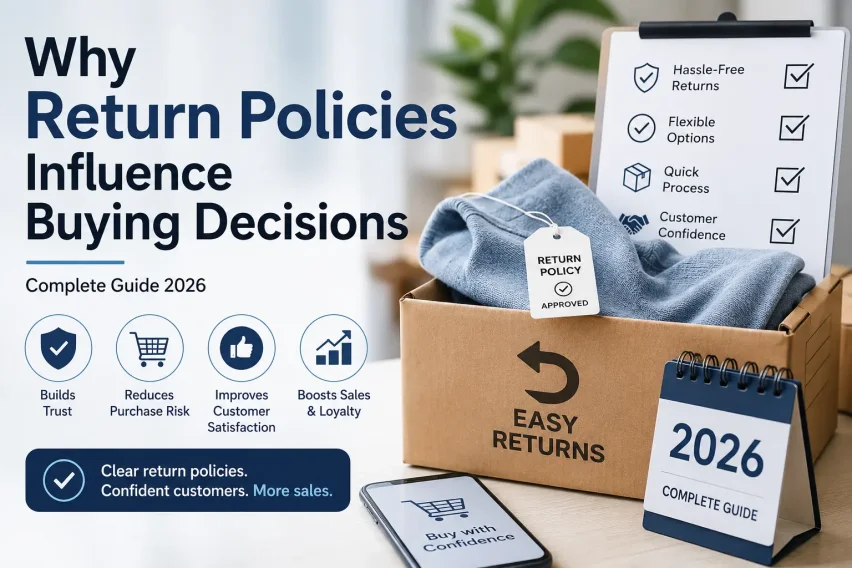
A silent calculation is always taking place in the back of a shopper's mind each time they place an item in their shopping cart: What happens if this doesn't work out? That one question, and the answer your store provides, can make or break whether or not your customer completes their purchase. Why return policies influence buying decisions is not a mystery. It comes down to one fundamental principle: people buy more confidently when they know they can undo a mistake. In 2026, a well-crafted return policy is not just a customer service detail; it is a core pillar of eCommerce strategy.
This guide explains all the information you should know, why return policies matter, how they influence consumer buying behaviour, and what the ideal online return policy is for your store.
A return policy is a set of guidelines that a retailer establishes to govern how customers can send back purchased products and receive a refund, store credit, or product exchange. A complete return and refund policy typically covers:
There is a lack of ambiguity when there is a good customer return policy that is transparent. If it's too broad or too narrow, it creates friction, and friction ends purchase intent before any sale occurs.
Consumers should not ignore return policies, as they can make a difference in their shopping experience. Ask any experienced online retail merchant, and they will tell you the same thing: online shoppers check the return policy before they purchase. This is not a case study. It's been proven by research again and again that the majority of online shoppers check the return and refund policy before completing their purchase, and a considerable number abandon their cart entirely if the policy is unclear or too complicated.
Here is why return policies matter to customers so deeply:
Customer trust is the currency of eCommerce. Even the most effective products don't turn browsers into buyers without it. One of the fastest and most reliable ways to build customer trust is through a flexible return policy.
Consider what a flexible return policy communicates to a potential buyer:
These signals matter enormously to buyer confidence. A shopper who trusts a brand is not just more likely to complete their first purchase; they are more likely to return, spend more, and recommend the store to others.
Extended return windows are particularly powerful. A standard 14-day return window creates pressure; a 30-, 60-, or even 90-day window removes it. Interestingly, research in consumer psychology shows that longer return windows often result in fewer actual returns, because customers feel less rushed and therefore less anxious about their purchase.
Free returns take this a step further. When a customer knows they will not be penalised financially for changing their mind, purchase confidence increases dramatically. For categories like clothing, footwear, and electronics, where fit, feel, and functionality are difficult to assess online, free returns can be the single biggest conversion lever available.
The impact of return policies on buying decisions is both direct and measurable. Here is how a customer return policy shapes behaviour at every stage of the shopping experience:
Do return policies increase online sales? The evidence is overwhelming and statistically significant: Yes. Retailers who invest in customer-friendly return policies typically see higher conversion rates, higher average order values, and stronger customer loyalty over time.
Customer satisfaction does not end at delivery. For many shoppers, it ends, or is confirmed, at the moment they need to make a return or ask a question about the refund process. This is the moment of truth that separates brands with genuine customer experience commitments from those paying lip service to it.
A seamless online shopping returns experience includes:
The brands that excel at customer satisfaction treat every return not as a loss, but as an opportunity. An easy, respectful, hassle-free returns process turns a potentially negative moment into a brand-building one.
The counterintuitive truth of eCommerce return policy strategy is this: making it easier for people to return things makes them more likely to buy and less likely to actually return.
Here is the logic behind how easy returns increase sales:
Some of the strongest return policy examples come from retailers who have made hassle-free returns a core part of their brand identity. Looking at how leading UK and European retailers structure their customer return policy offers a practical blueprint for any business.
One of the most cited return policy examples in online retail, ASOS offers a generous return window and a simple, app-based returns process. Returns are typically free if your personal return rate is below 70%, but frequently returning the majority of your orders may trigger a £3.95 deduction. Items must be unworn, with all original tags attached. This flexible return policy is widely credited as a major reason the brand built such strong customer loyalty among younger, fashion-focused shoppers who frequently order multiple sizes.
Operating across most of Europe, Zalando built its entire eCommerce reputation around free returns and an extended return window in many markets. This buyer-protection-first approach has made Zalando one of the most trusted names in European apparel retail, directly fuelling its rapid growth. Zalando Germany is well known for free returns and customer-friendly return options. Items must be unworn, in their original condition, and have all tags attached.
Known for exceptional customer service, John Lewis pairs a clear return and refund policy with in-store and online flexibility, including free returns to physical shops. This accepts returns or exchanges of unwanted items within 30 days of purchase or receipt. Items must be unused, in their original condition with all tags and labels intact, and accompanied by proof of purchase (e.g., receipt or order confirmation). This omnichannel retail return policy strengthens consumer trust and reinforces the brand's premium, dependable reputation.
M&S offers an extended return window along with free returns to the store, making it simple for customers to shop online without purchase hesitation. Marks and Spencer (M&S) in the UK offers a 28-day return policy for a full refund or exchange on most full-priced items. The policy is frequently highlighted as a key driver of repeat online shopping behaviour among loyal customers.
While primarily known for furniture, IKEA's long return policy in several European markets is a standout example of how a customer-friendly return policy can reduce the perceived risk of big-ticket purchases, encouraging purchase confidence even for large, considered buys. IKEA's Europe-wide return policy, including Sweden, offers a generous 365-day window to return most products for a full refund. Items can be returned opened, assembled, or unopened, provided they are unused and undamaged and you have your proof of purchase (receipt or digital order confirmation).
Decathlon's straightforward exchange policy and long return window support its high-volume, multi-category retail model, demonstrating how return policy benefits scale effectively across very different product types. Decathlon offers a 30-day return window for non-members, which extends to 365 days for free Decathlon Members, provided the items are unused and in original condition. Returns are entirely free in-store, though online mail-in returns may require you to pay for postage. Additionally, all Decathlon-branded products are backed by a 2-year manufacturer warranty against defects.
Next combines a well-known easy return policy with flexible drop-off points, including stores, lockers, and courier collection, giving customers multiple low-friction ways to complete a product return request, a model many smaller eCommerce business owners look to as inspiration.
What unites these brands is not just generosity, but clarity and consistency. Each one treats its online return policy as a visible, trust-building feature rather than a hidden legal formality, proof that investing in customer satisfaction at the returns stage pays off in long-term brand loyalty.
Why return policies influence buying decisions is ultimately a story about trust. Every element of a strong online return policy—the return window, the free returns offer, the simplicity of the refund process, and the tone of the language—communicates something to the shopper. It tells them whether a brand respects them, stands behind its products, and sees them as a long-term customer rather than a one-time transaction.
In 2026, eCommerce return policy is not a back-office detail. It is a front-line marketing tool, a customer retention engine, and a direct driver of purchase decisions. Brands that invest in building flexible return policies grounded in genuine customer satisfaction will find that the returns, in customer loyalty, in revenue, and in reputation, far outweigh the cost.
Hassle-free returns are not a concession to demanding shoppers. They are a statement of confidence, and confidence in online shopping is everything.