



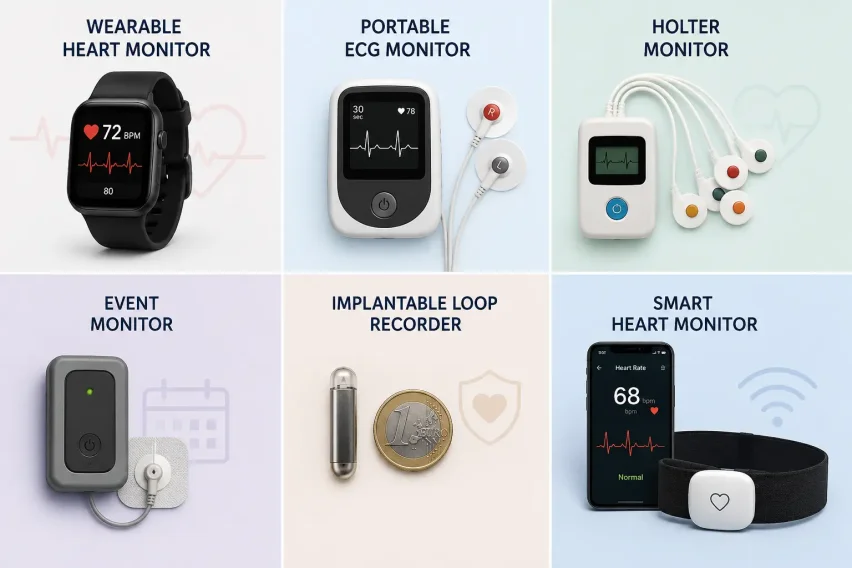
Keeping track of your heart health has never been easier. Thanks to advances in medical technology, you no longer need to visit a hospital every time you want to monitor your heart rhythm or record your heart rate. Today, a wide range of heart-monitoring devices are available for home use, travel, and professional medical care.
Whether you're managing an existing heart condition, investigating occasional symptoms, or simply taking a proactive approach to your well-being, choosing the right heart monitor can make all the difference.
But with so many options available, from wearable heart monitors and portable ECG monitors to Holter monitors and smart health devices, it's natural to wonder which one is right for you.
In this guide, we'll explain the different types of heart monitors, how they work, their advantages and limitations, and the situations where each device is most useful. We'll also compare trusted European brands and highlight the key features to consider before buying a heart monitor for home use.
| Heart Monitor Type | Best For | Typical Use |
| Wearable Heart Monitor | Everyday tracking | Daily heart rate monitoring |
| Portable ECG Monitor | Recording heart rhythm | Spot-check ECG recordings |
| Holter Monitor | Continuous monitoring | Medical diagnosis |
| Event Monitor | Occasional symptoms | Long-term rhythm recording |
| Implantable Loop Recorder | Rare heart rhythm issues | Specialist medical care |
| Smart Heart Monitor | Digital health tracking | Home and lifestyle monitoring |
Every type of cardiac monitor serves a different purpose. Some are designed for fitness and wellness, while others help healthcare professionals investigate irregular heart rhythms and other cardiovascular conditions.
Your heart works continuously, beating thousands of times every day to circulate oxygen-rich blood throughout your body. Because many heart conditions develop gradually, regular monitoring can sometimes help identify changes before noticeable symptoms appear.
For people living with high blood pressure, irregular heartbeat, or other cardiovascular conditions, keeping track of heart activity at home may provide useful information between medical appointments.
A home heart monitor can also help users track daily heart rate trends, record irregular heartbeats, monitor recovery after exercise, support long-term cardiovascular health, and share recorded data with healthcare professionals.
While consumer heart monitors are not intended to replace professional diagnosis, they can play an important role in helping people better understand their heart health and recognise changes that may require medical attention.
Although all heart monitors measure heart activity, they do not all work in the same way. Some devices use optical sensors that detect changes in blood flow beneath the skin. These are commonly found in wearable fitness devices and smart health monitors.
Others use electrical sensors to record the heart's electrical signals. These devices produce an electrocardiogram (ECG), offering a more detailed picture of heart rhythm and electrical activity.
Depending on the device, a heart monitor may record the following factors, such as heart rate, heart rhythm, ECG readings, irregular heartbeat alerts, and long-term heart health trends. Understanding how these technologies differ can help you choose the most suitable monitor for your personal needs.
Not everyone needs the same type of device. Before making a purchase, think about what you hope to achieve. Ask yourself:
Answering these questions will help narrow your options before comparing individual brands and features.
From simple wearable devices to advanced medical equipment, today's market offers solutions for almost every need. Understanding the strengths and limitations of each category makes it easier to choose a device that matches your lifestyle and health goals.
In the following sections, we'll take a closer look at each type of heart monitoring device, explain how it works, and discuss who it is best suited for.
One of the most popular options today is the wearable heart monitor. These lightweight devices are designed for continuous monitoring throughout the day and often connect to a smartphone via Bluetooth.
Depending on the model, they can record heart rate, resting heart rate, daily activity, sleeping trends, heart rhythm notifications, and exercise performance. Wearable monitors are ideal for people who want to keep an eye on their cardiovascular health without interrupting their daily routine.
While wearable devices are excellent for general health monitoring, they should not replace professional medical testing when symptoms require further investigation.
A portable ECG monitor records your heart's electrical activity and can provide more detailed information than a standard heart rate monitor. Unlike fitness-focused wearables, these devices are designed to capture ECG recordings whenever symptoms occur.
Many portable models are compact enough to fit into a pocket, making them convenient for travel or occasional use at home. They are commonly used by people who experience palpitations, irregular heartbeats, fluttering sensations, occasional dizziness, and unexplained rapid heart rates.
Several European manufacturers now offer compact ECG devices that integrate with smartphone apps, allowing users to save reports and share them with healthcare professionals if needed.
Portable ECG monitors are generally intended for spot checks rather than continuous monitoring.
A Holter monitor is a small portable device prescribed by healthcare professionals to continuously record your heart's electrical activity over an extended period, typically 24 to 48 hours, though some are worn for longer. Unlike a portable ECG monitor that records only when you activate it, a Holter monitor works continuously while you go about your normal daily routine.
Electrodes attached to your chest connect to a lightweight recording unit, allowing doctors to review your heart rhythm over time. A Holter monitor may be recommended if symptoms occur frequently, such as irregular heartbeat, fainting episodes, dizziness, unexplained chest discomfort, and rapid or slow heart rhythms.
Advantages
Limitations
Because it is a medical diagnostic device, a Holter monitor is usually supplied through a healthcare provider rather than purchased for everyday home use.
Unlike Holter monitors, event monitors are designed for people whose symptoms occur less frequently. Instead of recording continuously, they capture heart activity when the user presses a button after noticing symptoms. Some newer devices automatically detect abnormal rhythms and begin recording without manual activation. An event monitor may be worn for several weeks, increasing the chance of recording occasional heart rhythm changes that might not appear during a standard ECG.
Advantages
Limitations
These devices depend on symptoms occurring while the monitor is being worn, although automatic detection features can help capture unexpected events.
An implantable loop recorder is a small device placed just beneath the skin by a healthcare professional. It continuously monitors heart rhythm for months or even years, making it useful for investigating rare or unexplained episodes that are difficult to detect with short-term monitoring.
Because implantation requires a minor medical procedure, this type of cardiac monitor is reserved for specific clinical situations and is not intended for routine home use.
Advantages
Limitations
It has several limitations along with advantages, such as requiring a medical procedure and only being used under specialist care; it is not perfectly suitable for general consumer monitoring.
For everyday health management, home heart monitors remain one of the most practical choices. These devices are designed for personal use and often combine ease of operation with reliable heart rate tracking. Some advanced models also include ECG functionality or irregular heartbeat alerts.
They are especially useful for individuals who want to:
As technology continues to evolve, many home heart monitoring devices now offer smartphone connectivity, cloud storage, and detailed health reports, making long-term tracking simpler than ever.
Smart health technology has transformed the way many people keep track of their wellbeing. Modern smart heart monitors combine heart rate tracking, ECG functionality, activity monitoring, and mobile app integration into one convenient device.
Unlike traditional monitors that only record measurements, smart devices help users identify long-term trends and organise health data in one place. Many can also generate reports that can be shared with healthcare professionals during appointments.
While these devices are excellent for everyday monitoring, they should be viewed as tools that support health awareness rather than replace professional medical advice.
Smart heart monitors are particularly suitable for people who want to monitor their heart regularly, prefer smartphone-based health tracking, exercise frequently, like viewing long-term health trends, and need reminders to take regular readings.
When shopping for heart monitoring devices, choosing a trusted manufacturer is just as important as selecting the right type of monitor. European brands are recognised for producing high-quality healthcare products that comply with strict safety and quality standards.
Here are some of the leading brands available across the UK and Europe.
It is best for everyday home monitoring. German healthcare company Beurer offers a wide range of health devices, including heart rate monitors, blood pressure monitors, and ECG products designed for home use.
Many Beurer devices feature easy-to-read displays, Bluetooth connectivity, smartphone apps, simple operation, and reliable measurement performance.
As a trusted European manufacturer, this brand focuses on delivering user-friendly products built with strong, reliable construction. By prioritizing everyday durability and intuitive operation over complex, unnecessary features, these monitors offer excellent value. Ultimately, they are ideal for anyone looking for dependable home health monitoring that provides accurate results without the added fuss of complicated technology.
French technology company Withings specialises in connected health devices that integrate seamlessly with smartphones.
It is designed for those who prioritize smart health tracking; these premium monitors allow users to automatically sync data, track heart rate, view long-term historical trends, and even record ECGs on compatible models.
The brand's standout strengths include its excellent mobile app, a cohesive health ecosystem, and a highly discreet, seamless design. While they represent a higher investment, they are perfect for tech-conscious users who want an effortless way to generate detailed health reports and keep their data synchronized across devices without any manual hassle.
Medisana is considered best for affordable home healthcare. This produces a broad range of personal healthcare products designed for everyday consumers. Its monitoring devices focus on ease of use, practical features, affordable pricing, and reliable performance. For first-time buyers, Medisana provides a good balance between functionality and value.
Swiss manufacturer Microlife has built a strong reputation for precision healthcare devices, earning a stellar track record for accuracy and reliability. Its products are widely recognized for dependable measurement quality and straightforward operation, creating a hassle-free experience for the user.
By focusing on consistent performance, these devices are perfectly suited for individuals who value long-term data consistency above advanced smart features. They offer a direct, practical approach to tracking health metrics without unnecessary complexity.
Rossmax offers practical healthcare devices explicitly designed for households with multiple users, making them the ultimate choice for family use. Its products focus on everyday functionality, frequently combining multi-user support with large, highly legible displays to ensure comfortable, stress-free operation for individuals of all ages.
By balancing reliable performance with a straightforward user experience, these monitors serve as a practical, dependable option for families looking to actively track and manage their heart health together at home.
Choosing the right heart monitor depends on your health goals rather than simply buying the most expensive model.
Ask yourself the following questions before making a purchase.
If you're only interested in tracking your heart rate during exercise, a wearable monitor may be sufficient. If you want to record your heart's electrical activity, a portable ECG monitor will usually be the better option. For ongoing medical investigations, your healthcare provider may recommend a Holter monitor or another specialised cardiac monitoring device.
Someone monitoring their heart every day may benefit from Bluetooth connectivity and smartphone apps. Occasional users may prefer a simpler device without additional technology.
Large displays, intuitive controls, and clear instructions can make regular monitoring much easier, especially for older adults.
Memory storage is useful for identifying long-term trends and sharing information with healthcare professionals.
Whether you choose a wearable device or a home monitor, comfort matters. A device that's easy to wear or operate is more likely to be used consistently.
Even high-quality heart monitoring devices can produce misleading information if they aren't used correctly. Here are a few common mistakes: using the device incorrectly, ignoring the instruction manual, forgetting to charge wearable monitors, assuming consumer devices replace professional diagnosis, relying on a single reading instead of looking at long-term trends, and delaying medical advice when symptoms persist.
Heart monitors are valuable tools, but they work best as part of an overall approach to managing your cardiovascular health.
The main types include wearable heart monitors, portable ECG monitors, Holter monitors, event monitors, implantable loop recorders, smart heart monitors, and home heart monitoring devices. Each serves a different purpose depending on whether you need routine monitoring, fitness tracking, or medical diagnosis.
For general home monitoring, wearable heart monitors and portable ECG monitors are among the most popular options. The right choice depends on whether you want simple heart rate tracking or more detailed ECG recordings.
Many portable ECG monitors provide reliable recordings when used according to the manufacturer's instructions. However, they should not replace professional medical evaluations.
Understanding the different types of heart monitors makes it much easier to choose a device that matches your lifestyle and health goals.
For everyday monitoring, wearable heart monitors and home heart monitoring devices offer convenience and simplicity. If you require more detailed information about your heart rhythm, a portable ECG monitor may be a better choice. Holter monitors, event monitors, and implantable loop recorders are specialised medical devices used under the guidance of healthcare professionals for diagnosing specific heart conditions.
When comparing products, don't focus solely on price. Consider measurement reliability, ease of use, comfort, data storage, and the reputation of the manufacturer. Trusted European brands such as Beurer, Withings, Medisana, Microlife, and Rossmax provide a range of options to suit different needs and budgets.
We believe buying decisions should be based on clear information rather than marketing claims. That's why we independently compare healthcare products, evaluate their features, and explain what matters most to everyday users. Whether you're looking for a simple home monitor or exploring advanced ECG technology, our goal is to help you choose with confidence before you buy.