



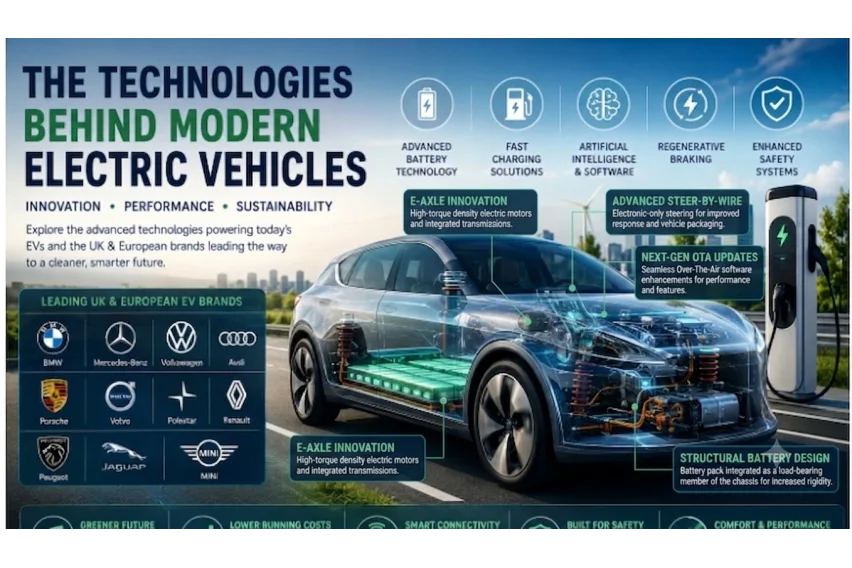
Electric vehicles (EVs) have moved far beyond being a niche alternative to petrol and diesel cars. Across the UK and Europe, more drivers are choosing electric mobility because it offers lower running costs, reduced emissions, and access to some of the most advanced automotive technology available today.
What makes today's EVs so impressive isn't just the electric motor under the bonnet. Behind every modern electric vehicle is a combination of intelligent software, powerful batteries, advanced safety systems, connected services, and innovative engineering that work together to deliver a smoother, quieter, and more efficient driving experience.
The rapid evolution of electric vehicle technology has also encouraged some of Europe's most respected automotive manufacturers to rethink how cars are designed, built, and maintained. German engineering, Scandinavian safety, French practicality, and British innovation are now helping shape the next generation of transportation.
In this guide, we'll explore the technologies behind modern electric vehicles, explain how they work, and highlight the UK and European brands leading this exciting transformation.
Today's modern electric vehicles are essentially computers on wheels.
Unlike traditional cars that rely mainly on mechanical components, EVs use intelligent software to monitor everything from battery performance and energy consumption to navigation and driver assistance.
Many vehicles receive regular software updates without visiting a dealership, allowing manufacturers to improve performance, introduce new features, and strengthen security over time. This continuous development means many electric vehicles actually improve after purchase, a concept that was almost impossible with conventional cars.
Perhaps the biggest innovation in EV battery technology has been the dramatic improvement in driving range and charging speed.
Earlier electric vehicles were often criticised for their limited range. Today's batteries are lighter, more powerful, and capable of travelling several hundred kilometres on a single charge.
Manufacturers continue investing billions into new battery research to improve:
Many companies are now exploring solid-state batteries, which promise faster charging, higher energy density, and improved safety compared with traditional lithium-ion batteries.
Although this technology is still developing, it represents one of the biggest future breakthroughs in electric vehicle innovation.
One of the biggest concerns for new EV buyers has always been charging. Fortunately, fast charging technology has improved dramatically.
Modern rapid chargers can add hundreds of kilometres of driving range in less than an hour, making long-distance travel much more practical. Across Europe, charging infrastructure continues expanding rapidly, allowing drivers to travel confidently between cities and countries.
Many modern vehicles also use intelligent navigation systems that automatically locate nearby charging stations and estimate battery levels upon arrival.
This combination of software and charging infrastructure makes owning an electric vehicle far easier than it was only a few years ago.
Artificial intelligence plays a much bigger role than many drivers realise. Today's smart electric vehicles constantly analyse road conditions, driving behaviour, traffic patterns, and energy consumption. AI helps improve:
Some vehicles even learn driving habits over time, adjusting battery usage to maximise range based on daily routines. These intelligent systems make modern EVs safer, more efficient, and easier to drive.
Unlike conventional braking systems, EVs recover energy while slowing down.
This technology, known as regenerative braking, converts braking energy back into electricity and stores it inside the battery.
The benefits include increased driving range, reduced brake wear, better energy efficiency, and lower maintenance costs. Although drivers may not notice it immediately, regenerative braking is one of the reasons modern electric vehicles achieve such impressive efficiency.
Among European manufacturers, BMW has established itself as one of the leaders in electric vehicle technology. Its growing i Series, including the i4, i5, i7, and iX, combines premium design with intelligent software and advanced engineering.
BMW focuses heavily on creating vehicles that deliver both performance and sustainability. Some standout technologies include:
BMW's latest electric vehicles continuously monitor battery performance to maximise efficiency while providing a smooth driving experience. The company has also invested heavily in sustainable manufacturing, recycled materials, and renewable energy production across its European facilities.
For drivers looking for luxury, performance, and innovative technology, BMW remains one of the strongest choices available today.
Mercedes-Benz has successfully transferred its reputation for luxury into the electric era through its EQ lineup. Vehicles such as the EQE and EQS showcase how premium comfort and connected electric vehicles can work together seamlessly.
The highlight of Mercedes' technology is the MBUX Hyperscreen. This advanced digital dashboard stretches across much of the vehicle's interior, providing navigation, entertainment, climate control, and vehicle information through one intuitive interface.
Other impressive technologies include:
Mercedes-Benz also places a strong emphasis on passenger safety, integrating advanced driver assistance features that make long journeys both safer and more relaxing. Its commitment to combining luxury with innovation has helped the EQ range become one of Europe's most respected electric vehicle line-ups.
Volkswagen has taken a different approach by focusing on making electric mobility available to everyday drivers. Its ID. family, including the ID.3, ID.4, ID.5, and ID.7, offers practical electric vehicles suitable for families, commuters, and business users alike.
At the centre of Volkswagen's EV strategy is the Modular Electric Drive Matrix (MEB) platform.
This flexible architecture allows Volkswagen to build multiple vehicle types using the same technological foundation, improving efficiency while reducing production costs. The latest VW ID. models combine intelligent battery management and smart charging with advanced driver assistance and connected infotainment, all kept continuously up to date through wireless software updates for a seamless electric driving experience.
Volkswagen continues investing heavily in battery production and charging infrastructure, demonstrating its long-term commitment to sustainable transportation.
Audi has embraced the shift towards electric mobility with its growing e-tron range, proving that premium comfort and cutting-edge electric car technology can go hand in hand. Models such as the Q4 e-tron, Q6 e-tron, and Audi e-tron GT combine refined interiors with intelligent driving systems that make every journey more enjoyable.
One of Audi's greatest strengths is balancing performance with everyday practicality. Rather than focusing solely on speed, the brand has invested heavily in technologies that improve efficiency, safety, and driver confidence.
Key innovations include:
Audi also continues improving its battery management software, helping drivers maximise range while reducing charging times. Its premium design, advanced connectivity, and smooth driving experience have made the e-tron family one of Europe's most desirable electric vehicle line-ups.
Porsche proved that electric vehicles don't have to sacrifice excitement. The Porsche Taycan has become one of Europe's benchmark performance EVs by combining sports car handling with advanced EV technology.
Unlike many competitors, Porsche introduced an innovative 800-volt electrical architecture, allowing significantly faster charging than conventional 400-volt systems. This technology offers several advantages:
Inside the Taycan, drivers benefit from multiple digital displays, intelligent navigation, and connected services that continuously improve through software updates. For drivers seeking premium performance without compromising sustainability, Porsche continues setting new standards.
For decades, Volvo has been recognised for its commitment to vehicle safety. Today, the Swedish manufacturer is applying the same philosophy to modern electric vehicles.
Models like the EX30, EX40, and EC40 combine Scandinavian design with intelligent safety technology and sustainable manufacturing practices. Volvo equips its EVs with features such as:
The company is also committed to reducing its environmental impact through responsible sourcing of materials and increasing the use of recycled components. For families looking for an electric vehicle that prioritises safety, comfort, and sustainability, Volvo remains one of Europe's strongest choices.
Originally developed as Volvo's performance division, Polestar has grown into an independent premium electric vehicle brand. Its vehicles combine minimalist Scandinavian styling with sophisticated software developed in partnership with Google.
The Polestar operating system integrates:
Rather than overwhelming drivers with unnecessary features, Polestar focuses on creating a simple, intuitive driving experience. Its commitment to sustainable materials, transparent manufacturing, and software-driven innovation continues attracting environmentally conscious buyers throughout Europe.
Renault has played a major role in bringing electric vehicles to everyday drivers. Models like the Megane E-Tech and Scenic E-Tech demonstrate that advanced electric vehicle technology doesn't have to come with a premium price tag.
Renault focuses on:
Its continued investment in European battery production and electric vehicle manufacturing reinforces Renault's position as one of the continent's leading EV innovators.
Peugeot continues expanding its electric vehicle range with models designed for families, commuters, and business users. Vehicles like the e-208 and e-3008 combine attractive styling with efficient battery systems and modern driver assistance technologies.
Many drivers appreciate Peugeot's focus on delivering:
For consumers seeking a balance between affordability and technology, Peugeot remains a compelling European option.
Jaguar has embraced electrification through models like the I-PACE, combining luxury design with powerful electric performance. The brand has focused on delivering:
Jaguar's vision extends beyond individual vehicles, with ambitious plans to become an all-electric luxury brand in the coming years.
The MINI Electric brings the brand's iconic character into the electric era. Designed primarily for urban drivers, it offers responsive handling, compact dimensions, and a premium interior while maintaining the fun driving experience MINI is known for. Its technology includes:
For city commuters, the MINI Electric offers an enjoyable and practical introduction to electric mobility.
Reliable charging infrastructure is just as important as the vehicle itself. Several UK and European companies continue expanding charging networks that make electric driving increasingly convenient.
Pod Point has become one of the UK's most recognised home and public charging providers. Its chargers are designed for easy installation, intelligent scheduling, and efficient home charging.
bp pulse continues investing heavily in rapid charging infrastructure across the UK, helping drivers recharge quickly whether travelling locally or long distances.
Supported by several leading European manufacturers, Ionity operates one of Europe's largest high-power charging networks. Its ultra-fast chargers are designed specifically for long-distance EV travel across multiple countries.
Shell Recharge has expanded rapidly throughout Europe, providing drivers with access to thousands of public charging locations through a single platform.
Together, these companies are helping remove one of the biggest barriers to EV adoption by making charging faster, easier, and more accessible.
Before buying an EV, look beyond price and appearance to evaluate daily livability: ensure its driving range and charging speed fit your travel habits, and confirm public charging compatibility alongside a strong battery warranty.
Additionally, prioritize long-term peace of mind by checking for reliable software support, advanced safety features, and intuitive interior technology while researching customer reviews and local after-sales service to guarantee a smooth ownership experience.
Reading expert reviews and comparing different brands can help you find the vehicle that best matches your lifestyle and budget.
Modern EVs combine EV battery technology, electric motors, regenerative braking, intelligent software, connected services, advanced safety systems, and fast-charging technology.
Brands such as BMW, Mercedes-Benz, Audi, Volkswagen, Porsche, Volvo, Polestar, Renault, Peugeot, Jaguar, and MINI continue investing heavily in electric mobility and connected vehicle technologies.
It captures energy normally lost during braking and sends it back to the battery, improving efficiency and increasing driving range.
Yes. Many modern EVs include collision avoidance systems, adaptive cruise control, lane-keeping assistance, intelligent driver monitoring, and advanced battery protection systems.
The technologies behind modern electric vehicles continue evolving at an impressive pace. Improvements in batteries, charging infrastructure, intelligent software, connected services, and driver assistance systems are making electric cars more practical than ever before.
At the same time, leading UK and European manufacturers, including BMW, Mercedes-Benz, Volkswagen, Audi, Porsche, Volvo, Polestar, Renault, Peugeot, Jaguar, and MINI, are proving that innovation doesn't have to compromise comfort, safety, or driving enjoyment.
As charging networks continue expanding and new technologies become more accessible, electric vehicles are set to play an even greater role in the future of transportation. Whether you're buying your first EV or upgrading to a newer model, comparing trusted brands, exploring detailed reviews, and checking available offers can help you make a well-informed decision.