


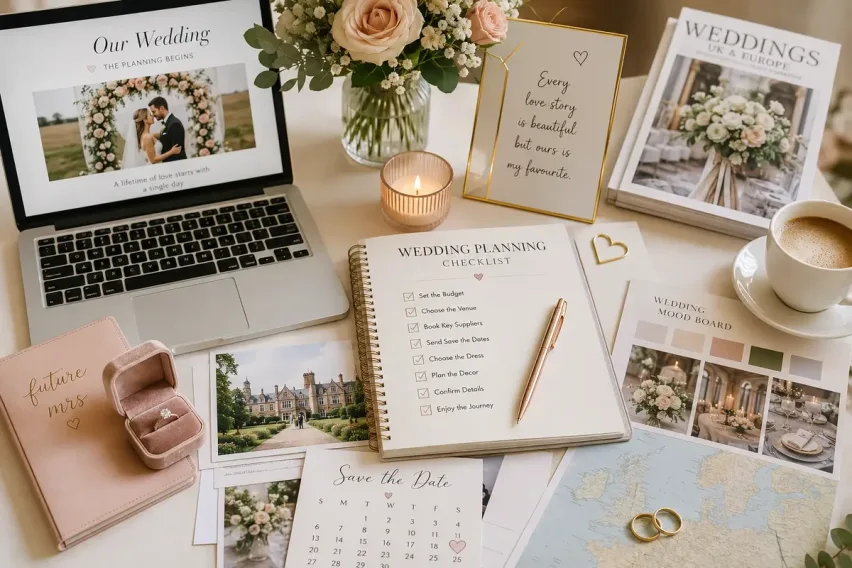

Getting engaged is such an amazing and exciting time. There are a lot of things to consider when planning your wedding like your budget, venues, suppliers, invitations & dresses.
Having a plan will help you when planning. You don’t have to plan every single thing but knowing your priorities, doing some research & breaking it down will help!
This guide will help you plan your wedding, whether it’s a big party, destination wedding or anything in between. This will give you some insight into what to consider whilst planning your wedding in the UK/Europe.
Think about what you would like, how many guests you want and your budget. Decide on a date and venue. Research and have a list of places to look at. This will help you to compare venues, keep your costs down and less stressful.
Before you start looking at venues and contacting suppliers have a chat about what you want from your day. Every couple will have priorities. Some will want a small gathering with just family and friends whilst others may wish to have a bigger event or destination wedding.
Talk about:
Ceremony style – Do you want a religious ceremony or something more informal?
Guests – How many guests do you expect?
Location – Do you want your wedding to be local or a destination wedding?
Date/Season – Do you have a specific month/season or date in mind?
Wedding Style – What vibe would you like?
Priorities – What are your main priorities?
It can also be useful to discuss what your family expects. Are they going to help with planning or with paying for the wedding? Discussing these priorities will help you make decisions together.
Setting a budget is a part of Wedding Planning. Without a budget costs can pile up. Decide how much you can comfortably afford. If family members or others will help pay for the wedding agree on how much they can contribute.
This could include:
Venue Hire
Food/Catering
Photography/Videography
Wedding Dresses (with alterations)
Flowers/Decorations
Entertainment/Music
Wedding Cake
Invitations/Stationery
Travel/Accommodation
Engagement/Wedding rings
Ceremony costs
Honeymoon costs
Create a spreadsheet to track estimated costs, supplier quotes, deposits and any outstanding payments. Update the spreadsheet as Wedding Planning moves forward. You may also want to set some money for unexpected expenses. The amount depends on your budget and the type of wedding you are having.
Tip: Divide costs into non-essential items to guide decisions about where to spend more.
If you compare costs for wedding outfits, decorations or other items, use our guide to weighing price against quality.
A checklist can help you stay on top of Wedding Planning. Depending on the timing of your wedding, the location and the availability of venues and suppliers, your planning schedule may vary.
Talk about priorities
Set a budget
Estimate number of guests
Research dates and locations
Start comparing venues
Confirm venue and date
Research key suppliers
Compare catering and entertainment options
Start thinking about your outfit style
Look into accommodation and travel
Create guest list
Send messages
Compare invitations and stationery
Talk about flowers and decorations
Confirm travel
Book fittings with suppliers
Send out invitations
Follow up with guests
Confirm menu with caterer
Check ceremony and reception timings
Confirm supplier contracts and any outstanding payments
Start organising seating plan
Confirm final guest numbers
Double check timings with suppliers
Check alterations
Create list of contacts, for suppliers
Double check travel/accommodation
Organise any outstanding payments
You can tailor this checklist to fit your Wedding Planning.
Depending on the number of guests you may need more time to plan a wedding. If you are having a destination wedding you may need additional time.
Choosing a venue can change parts of your planning. It can affect how many guests you can invite, what food you can serve, how the room will look, how guests will travel to the venue and how much you will spend.
When comparing venues think about more than the look of the venue.
Estimate how many guests you are inviting. Check that the venue has space for all guests to fit comfortably including seating, food and reception.
Think about how guests will reach the venue. Are there transport options, parking and local accommodation? If you are having a destination wedding think about flight times, local transport and accommodation.
If you are having an outdoor wedding check what backup options exist if the weather turns bad. Is there space? Will changing the layout cost extra?
Ask what the venue includes. Some venues may include furniture, catering, event coordination and/or accommodation. Others may charge separately. Ask for a breakdown of:
Venue Hire
Food/Drinks
Furniture/Equipment
Any restrictions on decorations
Cleaning costs
Staff and extra services
Deposit and Cancellation Policy
Comparing these items will help you know how much the venue will cost.
Wedding suppliers can include photographers, videographers, caterers, florists, entertainers and event coordinators.
Avoid picking a supplier just because the website looks nice or the quote is the lowest.
Take your time to compare what each supplier can offer, the cost and any terms.
Look for:
Portfolio – See examples of their work.
Customer Reviews – See what people say.
Costs – See what is included in the quote.
Availability – Confirm they are available on your wedding date.
Cancellation Policy – See what their payment, cancellation and refund terms are.
Communication – Ensure you are clear about what they will do, when and what you expect.
Ask any questions you may have about the quote or contract.
Keep copies of all agreements, invoices and payment confirmations.
Finding the wedding dress or outfit can take time. Consider your budget, style, venue and season before visiting any boutiques or clothing stores.
When comparing dresses, suits or any other outfits:
Comfort – Will it be comfortable to wear all day?
Fabric – Does the fabric suit your preferences and season?
Weather/Location – Will it suit your venue and expected weather?
Alterations – Will there be any alterations?
Delivery Times – Will it be delivered in time?
Returns – What happens if it does not fit or match your style?
Cost – Have accessories, shoes and alterations been included?
Look at different styles. Your outfit should match your style and be comfortable to wear.
If ordering online check the sizing guide, estimated delivery time and return policy.
Read our guide on how to shop online in the UK and Europe.
Your guest list can affect areas such as venue size, catering, stationery and seating.
Start by creating a guest list. Talk together.
Group your guests into family, friends and colleagues.
When choosing invitations:
Printed or Digital – What style do you want?
Design – Can they be personalised?
Printing Time – How long will they take to print and deliver?
RSVP – How will guests confirm they are attending?
Accessibility – Do they need to provide any information?
Stationery – Will you need any additional stationery such as menus, place cards or welcome signs?
Use a spreadsheet to keep track of who you have invited, who has responded and any requirements. This will help you confirm how many people you need to cater for.
Decorations can set the vibe of your celebration. You do not need to follow every trend. You can keep costs low.
Start by looking at the style of the venue. How much space do you have? Are there any restrictions?
Consider:
Colours – Choose colours to match the venue and your overall wedding style. Pastels, light greens or warm colours could work. Pick colours that match your preferences.
Flowers/Centrepieces – Consider using flowers, fake flowers or simple table decorations. Ask your florist what is available, delivery times and setup costs.
Lighting – Outdoor events can be changed with lighting. Ask the venue what lighting options and equipment they have and if they allow external equipment.
Personalised – Add personal touches that reflect your style.
Adding table names, signs, photos and personalised stationery can add personal touches.
Before purchasing decorations check if the venue has any rules about candles, hanging items, confetti or outside equipment.
Your engagement ring, wedding bands and gifts may be part of your Wedding Planning. Take your time to compare styles, materials, sizes and prices.
When researching jewellery:
Material – Know what material it is made from and how to care for it.
Size – Ensure it fits comfortably.
Style – Choose a style to match your preferences.
Care – Are there any cleaning or professional care requirements?
Warranty – Check what is covered.
Information – Check what materials, specifications and return policy it has.
If ordering online check what the seller’s policies are. Ensure the product description clearly states what materials and specifications it has.
When planning gifts for your Wedding think about household items, experiences or contributions to your future. Choose what is best for you.
With planning, unexpected changes can happen. Knowing what to avoid when planning your Wedding can help you manage Wedding Planning better.
Having a budget is not enough. Keep track of deposits, payments and any additional costs.
Before agreeing to anything check payment terms, cancellation policy, what is included and any additional costs.
Your guest numbers can impact venue size, catering and seating. Create a guest list.
Some venues and suppliers may not have availability. Research key services early. Contact them directly to see what their booking deadlines are.
The cheapest quote may not have everything you need. Compare what they can offer, terms and overall cost.
Wedding planning can involve a lot of tasks. Sharing the workload can help. Use a checklist to help both you and anyone helping you know what to do.
Wedding planning involves making decisions. Having a plan will help you manage Wedding Planning. Start by talking about priorities, setting a budget, researching venues, comparing suppliers and using a checklist.
There is no single way to plan a wedding. It is important to make choices based on your budget, location, guest list and personal preferences.
Stay focused on what's important for you as a couple. Know the details before paying for anything. Give yourself time to complete tasks and, most importantly, enjoy the experience!
For more practical advice on making informed shopping decisions, explore our shopping guides.
The Shoptique Editorial Team creates guides that help readers understand shopping, consumer technology and product specifications. These guides explain terms show how devices work and give clear information in plain language. We research carefully use sources and check facts before we publish.